A recent article in The Guardian newspaper strikes a critical tone over the Chinese government’s attempt to control food waste.
But according to Project Drawdown, reduction of food waste is the number one solution to reducing heat-trapping gases in the atmosphere, closely followed by health and education, then plant-rich diets.
Rather than criticise, perhaps we should be doing more to encourage less food waste – production, transport and consumption – ourselves.
The very first – Summer 2020 – edition of Bloomberg Green climate magazine aims to chronicle a new era of climate solutions alongside a frank appraisal of climate facts and figures: “The world has been brought low by the Covid-19 pandemic, but it has the means to rebuild itself better. Let’s take this era of climate solutions as seriously as our real fear of reaching a dead end.”
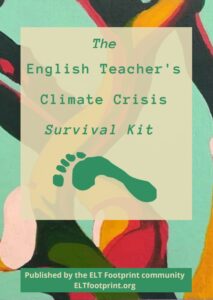
Thank you to ELTfootprint.org for (among other things) the excellent English Teacher’s Climate Crisis Survival Kit.
It’s full of ideas for helping practising English teachers to ‘Make their lessons more focused on the climate emergency and to make their place of work greener and more sustainable.’
If this article is to be believed, the body that regulates advertising in France has a record of protecting corporate interests over the interests of the environment. For example they banned this video promoting electric bikes because images of traffic might create ‘a climate of anxiety’! What’s the answer? Use the power of social media to counter their bias by sharing this video as widely as possible.
This from the excellent Resurgence and Ecologist Magazine for May/June 2020: “We need a new ideology based on connection: between individuals, between institutions, and between our societies and Nature. At the heart of this is education.” Food for thought indeed.
With shops in the UK reopening today the government seems desperate to get back to business as usual. And while no one wants to see the misery of high unemployment, it’s good to be reminded about ‘the absurdity of our “real world” politics and economics’ in the face of the physical reality of climate change.
So how do we build back better?
This article suggests we should learn from nature.
Why does this photo make me want to laugh and cry at the same time?
On the one hand, I’m amused that people would want to queue (socially distanced) for hours in a car park – as the caption says – for meatballs. Or at least for something flat packed that can probably wait.
On the other hand, I’m depressed that the lure of consumerism is so deeply ingrained in people that they feel the need to do this. Then there are the journeys these people have presumably made to get here, every one of them I would guess ‘non essential’ and contributing to the pollution load on our planet.
I loved the silence of lockdown, the clean air, the bird song, the empty roads briefly colonised by wildlife (and cyclists). But photos of shoppers queuing outside furniture stores and fast food outlets somehow suggest we have learnt nothing.
Especially this photo, from the air: the people look like ants, every individual choice adding up to a collective failure to understand that they are part of the problem. The store looks like nothing so much as a factory or a machine. People being fed into it.