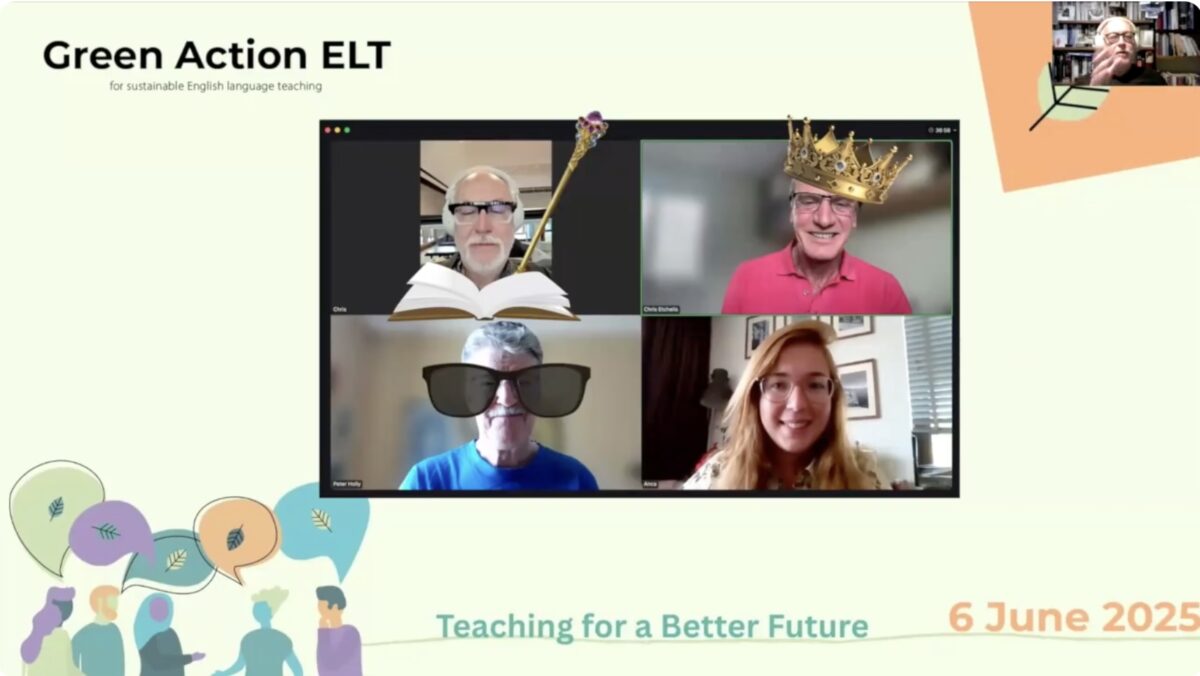
Videos from our Teaching for a Better Future conference are now available to watch online here.
Revisiting these sessions has only strengthened our appreciation for the insight, generosity, and inspiration our presenters brought to the event. A heartfelt thank-you to each and every one of them for helping make the conference such a meaningful experience.
Earthrise – the poem by Amanda Gorman – feels peculiarly relevant to COP26, both inside and outside the venue. Here is an excerpt, and a link to a new teaching resource I’ve created specially for COP26. I hope you and your students will enjoy it.
‘To see it, close your eyes. Visualize that all of us in this room and outside of these walls or in the halls, all of us changemakers are in a spacecraft, Floating like a silver raft in space, and we see the face of our planet anew. We relish the view; We witness its round green and brilliant blue, Which inspires us to ask deeply, wholly: What can we do? Open your eyes. Know that the future of this wise planet Lies right in sight: Right in all of us. Trust this earth uprising. All of us bring light to exciting solutions never tried before For it is our hope that implores us, at our uncompromising core, To keep rising up for an earth more than worth fighting for.’
Day 1 of COP26 and we have heard some impressive opening statements. And though words are important, we – all of us watching now, as well as future generations – will judge our leaders by their actions, not by their words.
Bolovian President Lui Arce said that developed nations are “just biding their time without facing any sense of responsibility toward humanity or towards Mother Earth.”
“Their credibility is at peril,” he said. “The developed countries are coming up with speeches that portray them as champions to combat climate change and to address emissions by 2050, but this is far from being the truth.” So we wait, wish them well and will hold them to account.
Meanwhile, in hope rather more than expectation, here is some environmentally themed music from the excellent Outrage and Optimism podcasts. Enjoy!
A newly released Netflix documentary, “Breaking Boundaries: The Science of Our Planet,” features David Attenborough and Johan Rockström, one of the scientists who introduced the concept of planetary boundaries.
The film sounds alarm on planetary boundaries, but offers hope.
Highly recommended: read more here and watch the film here. #GreenELT
Amazing that it still takes a teenager to join the dots, clearly setting out the problems and the solutions in a way that our political leaders generally fail to do:
Outrage and Optimism is a weekly podcast that provides everything you need to keep up to date with the latest environmental developments: ‘We explore the challenges, frustrations and genuine outrage we need to face this crisis, and we explore the real changes already happening that offer the stubborn optimism we need to play our part in building a thriving new economy and world.’
This week’s podcast is about the nature agenda and how we cannot deal with the climate crisis without also addressing nature. Some wonderful music too from Marie Spaemann.
#TheClimateConnection podcast series from The British Council starts 12 May. It explores the relationship between the climate crisis and language education.
Ten episodes will feature a wide range of leading practitioners working in the sector – teachers, trainers, researchers, publishers and authors – from Colombia to China, Moldova to Mali, and Palestine to Poland.
In partnership with the Oxford English Dictionary, you’ll also learn more about the origins of climate-related language.
“This is one of the most consequential decades in human history. That might sound like an exaggeration but it’s not.
By 2030 either we will have reduced emissions by 50% and will be well on our way to a regenerative world where we turn things around at the last minute; or we will have begun to lose control over our climatic system and it will matter less what we do after that.”
These are the words of Tom Rivett-Carnac who, alongside Christiana Figueres, helped bring about the successful Paris Agreement on climate change.
But one of the problems for people aware of the reality of our situation and wishing to do something about it, is burnout. So we need to strike a balance between being in touch with what is going on, without being overwhelmed by it; and take time to come back to ourselves to find a place of centred calm from where we will develop the resilience to do the work we need to do. So says Rivett-Carnac’s life coach, Jo Confino.