

Join our online events to Learn from experts and each other and connect with like-minded colleagues.
All events are free and open to everyone in language education. Whether you’re new to environmental action or full of ideas to share, join us – and bring your colleagues and friends!
Recent events
Friday 8th May 2026
Pathways to Action: Embedding Sustainability in ELT
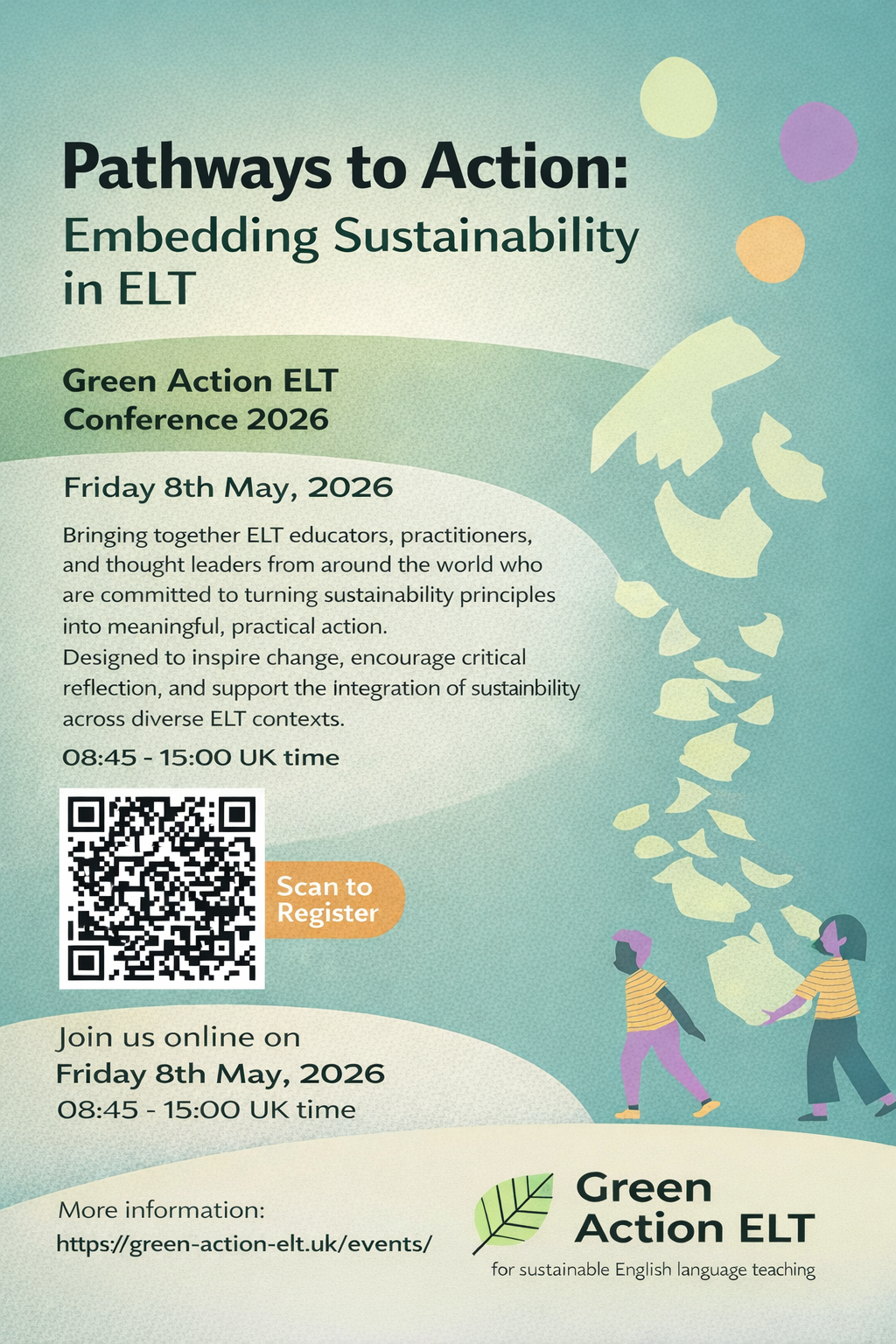
Online Conference | Friday, 8 May 2026 | 08:45 – 16:00 (GMT)
How can English Language Teaching (ELT) contribute to a more sustainable world?
Pathways to Action: Embedding Sustainability in ELT brought together educators, practitioners, and thought leaders committed to turning sustainability principles into meaningful, practical action. This one-day online conference showcased a range of presentations designed to inspire change, encourage critical reflection, and support the integration of sustainability across diverse ELT contexts.
Presentations:
Introducing EcoLens Education: Visual Literacy for Climate Education
Colm Downes & Jade Blue
Watch video here
This session introduces EcoLens Education, a practical framework for developing visual literacy in climate education. It explores how images influence understanding, emotions, and beliefs about the climate crisis, and how poorly chosen visuals can reinforce stereotypes or disengagement. Through real examples, participants are shown how more intentional image use can foster agency and engagement. The session presents the EcoLens Guidance Model and offers practical strategies for applying visual literacy in ELT contexts.
Pathways to Action: Emotional Intelligence for Sustainability in ELT
Rihan Mustapha
Watch video here
This session examines how emotional intelligence can support sustainability-focused English language teaching. It demonstrates how self-awareness, empathy, and reflection can be integrated into language tasks linked to real-world issues. Through examples and a short demonstration, participants are introduced to practical, adaptable approaches that enhance communication and learner engagement across a variety of teaching contexts.
Collaboration and Celebration: working together to create a Sustainable Resources Bank
Hannah Tucker-Bloom
Watch video here
In this session, on behalf of Green Action ELT, Hannah will share an overview of our (new) shared materials bank, with some suggestions for how the many ideas, suggestions and tasks that promote sustainable teaching can be adapted for your contexts and students.
Debating Green Topics in the English Language Classroom
Anila R. Scott-Monkhouse
Watch video here
This session explores the use of structured debates to combine language learning with sustainability education. It outlines the pedagogical benefits of debate for engagement and meaningful communication, and explains why environmental topics are particularly suitable. The session also provides practical classroom strategies and examples for implementing debates across a wide range of proficiency levels.
Green Topics and Grey Areas in ELT Publishing
Daniel Barber
Watch video here
This talk explores the opportunities and challenges of integrating sustainability content into published ELT materials. Drawing on practical experience, it examines what publishers are willing to include, what they tend to avoid, and the reasons behind these decisions. It addresses tensions around market sensitivity and offers practical principles for materials writers, while considering the implications for teachers and learners engaging with sustainability topics.
Building Inclusive and Socially Sustainable Classrooms through Stereotype Literacy
Josianne Block & Armanda Stroia
Watch video here
This session focuses on stereotype literacy as a tool for promoting social sustainability and inclusion in English language education. It introduces a three-phase framework that helps learners identify stereotypes, critically analyse biases, and create inclusive narratives. Through practical activities, participants explore ways to empower students to challenge inequalities and develop as socially responsible individuals.
EcoMakers: When ELT Students Become Sustainable Entrepreneurs
Taíla Gimenez
Watch video here
This presentation introduces the EcoMakers Project, a project-based approach that integrates sustainability, entrepreneurship, and language learning. Students engage with the UN Sustainable Development Goals by creating eco-friendly products and running mini companies, taking on roles such as marketing and finance. The session showcases project stages, student outcomes, and practical strategies for implementing similar initiatives that promote collaboration, problem-solving, and meaningful use of English.
View the full conference programme here
6 March 2026
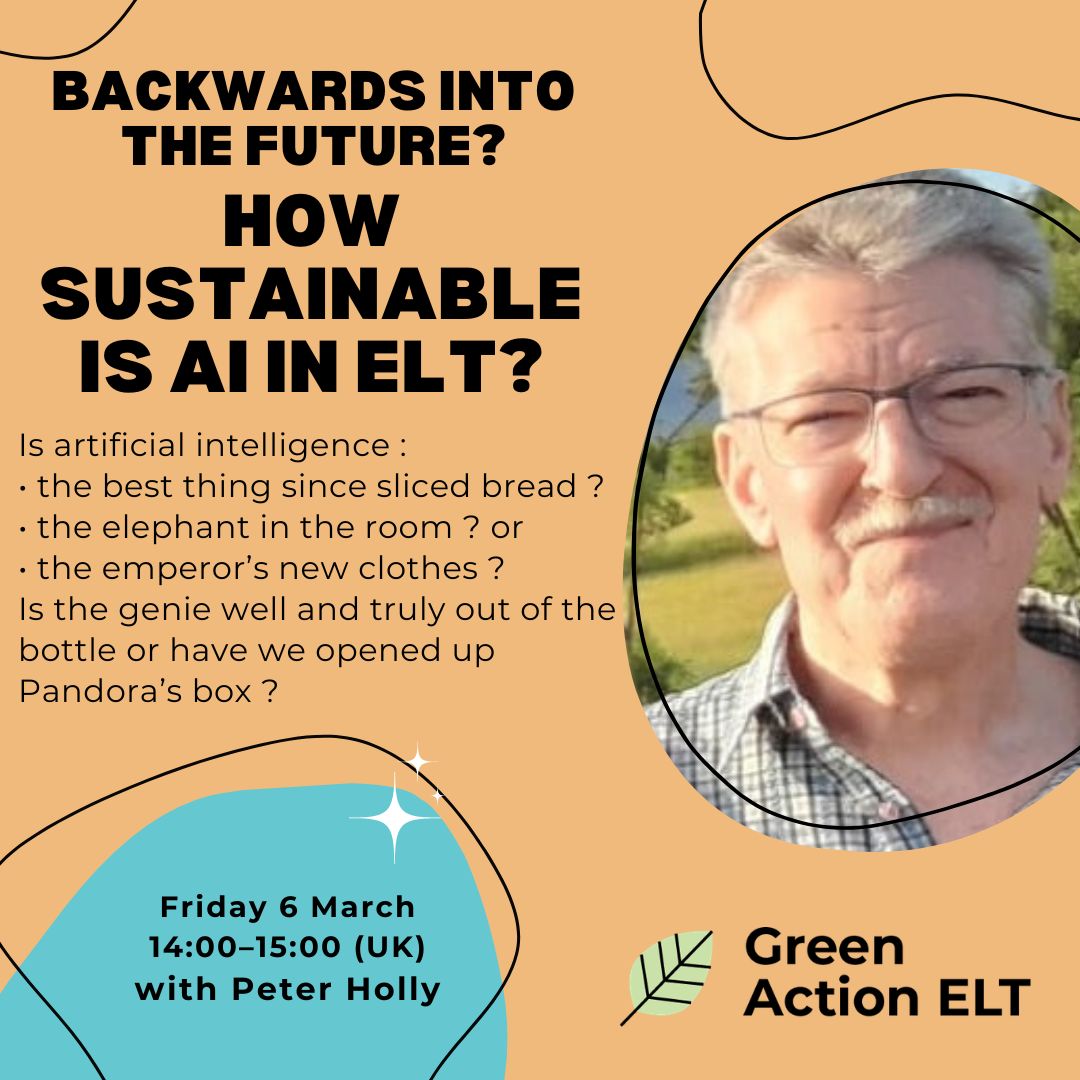
The rise of Large Language Models is transforming education at an unprecedented pace – but are we ready?
Is using AI with our learners always ethical? Is it always pedagogically sound? Should we feel compelled to integrate it into our classrooms – or pause to question its role? And if we do choose to use it, what critical questions must guide our decisions?
This webinar invited educators to step back and examine the bigger picture. Beyond immediate classroom applications, how do we future-proof ourselves professionally and support our learners not only academically, but developmentally, in an age of generative AI?
The genie is out of the bottle – but have we opened Pandora’s box?
We explored the broader global implications as well. Beyond Sustainable Development Goal 4 (Quality Education), how do AI technologies intersect with other SDGs? What are the implications for decent work, economic growth, clean energy, clean water, responsible consumption, infrastructure, and inequality?
Lots of questions! To which experienced educator Peter Holly offered informed reflections, practical considerations, and plenty of food for thought as we explored what sustainable, ethical, and future-focused ELT might really look like in 2026.
New Year Check-In
Friday, 23 January 2026 | 11:00 CET
We met new committee members: Stephen Farren (Northern Ireland), Marcela Villan (Argentina), and Stephany Carrasco Sardon (Colombia). We exchanged ideas, built connections, and learn from colleagues who share our commitment to creating positive change through English Language Teaching.
We also announced our new WhatsApp group to help participants continue the conversation across time zones after the webinar.
Green Educator Conference – Teaching For A Better Future
Online Conference | Friday, 6 June 2025 | 11:45 – 17:30 (GMT)
Conference videos now available here
A powerful day of inspiration, innovation, and action, a dynamic online conference for educators who believe language teaching can be a force for environmental and social change. This collection of presentations is a call by educators on three continents to transform classrooms into catalysts for a greener, more conscious world.
Green Action ELT: who are we and what do we do?
Conference introduction, including opening remarks by Christopher Etchells: Can we still talk about a better future?
Gamify Sustainability with Georgia Papamichailidou as she opens her “Diary of a Green Leader” and reveals how games, storytelling, and playful leadership can spark eco-consciousness in learners and staff alike.
Write for the Planet with Marla Lise and George Jacobs. Discover how writing—whether reflective or activist—can empower both young and adult learners to express their environmental values and inspire change.
Teach the SDGs through Speaking & Listening with Hannah Tucker-Bloom. Dive into an integrated curriculum model that connects English learning to the UN’s Sustainable Development Goals in meaningful, level-appropriate ways.
Planet-based Classroom Hacks with Harry Waters. From mindful greetings to mini green projects, learn practical tweaks you can implement tomorrow to weave sustainability into your lessons—without extra prep.
Think Green, Teach Smart with Marcela Villan. Learn how systems thinking can enrich your ELT practice and empower students to see the interconnectedness between language, society, and our planet.
More Green, Less Screen with Lucy Crichton. Discover playful, screen-free project ideas for young learners that nurture environmental awareness through gardening, nature play, and mud kitchens.
Empowering Green Women Leaders with Stephany Carrasco Sardon. Explore a bold, Latin American initiative showcasing women-led environmental projects, and rethink how storytelling, design, and education intersect for real impact.
VIEW THE FULL PROGRAMME HERE
Green Accreditation

Friday 25 April 2025
Three short presentations on different types of green accreditation for educators and organisations, with Jonathan Dykes from Green Standard Schools, John Crick from Aspire.Sustain and Chris Etchells on the Green Action ELT Pledge.
An informative session for anyone interested in proving their green credentials, free or paid, from freelancers to organisations.
WATCH THE VIDEO HERE

New Year Check In
Friday 31 January 2025
What Can We Do in a World On Fire?
This consisted of four, 5-minute presentations from members of the steering team:
Presentation 1 (Peter Holly): Sustainability Development Goals, Inner Development Goals and 21st Century Skills.
Presentation 2 (Chris Graham): Can anger help our students engage with the climate crisis; and should we encourage our learners to be eco warriors?
Presentation 3 (Anca de Vries): Making the climate crisis fun in the English classroom.
Presentation 4 (Chris Etchells) : Help in setting up and running a school Eco Team.
Watch videos of these presentations here

Intersectionality, ELT and climate change – piecing it all together
Friday 27 September 2024
The causes and the negative impact of the climate crisis are interconnected with a large number of socio-economic, political and cultural issues both local and global. The two talks and the subsequent discussion will explore these connections and their impact and suggest some implications for EFL teachers seeking to integrate climate change topics into their lessons.
Rose Aylett is a freelance training consultant and CELTA tutor, based in Liverpool. She has been working in ELT for almost 20 years, predominantly in Europe, the Middle East and North Africa, and has a long-standing professional interest in critical pedagogy, global citizenship and social justice education. She speaks regularly at national and international conferences about how to teach controversial issues, promoting critical dialogue in the classroom, and the integration of critical perspectives into ELT.
Zarina Subhan originally qualified as a scientist, but has been working in the field of ELT for over 30 years. She has taught at all levels, in both private and government institutions and worked worldwide as a teacher and teacher educator. Having worked both in and with educational institutions, she also has experience working with educational policy makers, NGOs, community leaders, local and state governments and in a variety of training contexts. Zarina’s time is now spent between delivering teacher training, conference presentations, speaking on educational topics, and writing. Having worked in the science, educational and development sectors, her interests are the neurology of learning; CLIL; continuing professional development for teachers; inclusive and sustainable education.
Suggest an event
If there are topics you would like us to cover or speakers you recommend, please email us.